
Executive summary
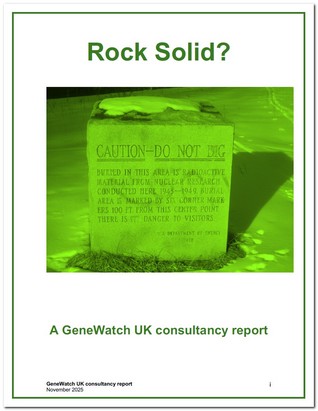
No country has yet completed an operational geological disposal repository for high-level radioactive wastes or spent nuclear fuel resulting from nuclear electricity generation, despite commitments adopted in the 1970s.
The nuclear wastes intended to be sent to a deep geological repository are those generated in the core of the nuclear reactor, either spent nuclear fuel itself, or high-level wastes which are part of the spent nuclear fuel (separated from it using the chemical process called nuclear reprocessing). Each reactor is re-fuelled multiple times during its lifetime, therefore the quantities of radioactivity from any national nuclear power programme are many times greater than have ever been released during a nuclear accident.
These wastes generate significant quantities of heat and are highly radioactive. Studies suggest that the heat is sufficient to create an uplift of the rock at the ground surface of around 10 cm or more, around 1 000 to 2 000 years after such wastes are buried around 500 m beneath the surface. The heat and radiation, plus the damage and disturbance caused to the rock and groundwater when the repository is excavated, create a major disturbance to the conditions underground at the repository depth. Repository conditions will evolve over time over the order of 100 000 years before returning to the steady state of the undisturbed geology (assuming no major disturbances, such as earthquakes, glaciation or human intrusion in that time). Even then, excavation damage will remain and could provide fast routes for radioactive water or gas to leak from the repository. The wastes will remain radioactive for even longer: thus, the design life of a deep geological repository is intended to be up to a million years.
Construction of a repository requires a significant financial commitment and excavation of very large quantities of rock. This is many times the volume of the wastes, due to the need to space canisters widely to prevent the repository temperature rising above100°C. During the operational phase (emplacement of wastes), there is a risk of accidents. However, the focus of this report is on post-closure risks, i.e., the period of time after the repository has been filled in and is no longer intended to be actively managed. Over time, radioactive substances (radionuclides) will leak from the repository into the surrounding groundwater and/or be released as radioactive gas. The safety case for a deep geological repository relies on containment of some of these radionuclides and dilution and dispersion of others, through the surrounding rock and biosphere. These processes are intended to take place sufficiently slowly that much of the radioactivity decays before it reaches the surface and thus doses of radioactivity to future generations are intended to be very low.
The deep disposal concept rests on three premises:
- The packaging (canisters, backfill – usually containing clay – surrounding them, and further backfill in the excavated tunnels and deposition holes) will be able to withstand the intense heat and radiation from the wastes and the high stresses this creates in the surrounding rock.
- The complex chemical and radiological changes that will occur over an extremely long period are well enough understood to ensure that the integrity of the waste containers and backfill is maintained for tens of thousands of years.
- A site can be identified that meets the necessary geological requirements over a period of hundreds of thousands of years.
Based on a literature review of papers in scientific journals, the present report provides an overview of the status of research and scientific evidence regarding the long-term underground disposal of highly radioactive wastes. The focus is on spent nuclear fuel and high level waste, which is heat-generating. However, some issues associated with the disposal of lower-level wastes are also noted, where these are intended to be sent to the same repository (usually in a separate section). In particular, these lower-level wastes contain organic material and are expected to generate significant quantities of radioactive gas which could leak into the environment and/or disturb the combined repository.
Many countries have failed repeatedly to identify suitable sites for deep geological disposal, despite numerous attempts, and may never be able to do so. Several countries are now actively investigating alternatives, such as deep borehole disposal (several kilometres underground), combined with longer-term dry storage. However, a number of countries have selected sites for deep geological disposal, or are close to doing so.
Finland has constructed a repository but has yet to bury any nuclear waste in it. Sites have also been selected in Sweden, France, Canada and Russia, with only Sweden so far being close to authorisation to begin underground construction. Site selection involves a major commitment to a particular geology and deep disposal concept. There are two main such concepts:
- In hard fractured rock (such as granite), copper canisters contain spent nuclear fuel and are surrounded by bentonite clay (intended to swell and hold the containers in place, protect the canisters from chemical degradation, and to delay the release of some radionuclides) (e.g., Sweden, Finland);
- In clay rocks, steel containers are used for vitrified high-level waste (i.e. high- level waste sealed in glass), and clay, or a mix of crushed clay rock, sand and/or clay is used as backfill (e.g., France).
There are some variations. For example, whilst Sweden and Finland propose using 5 cm thick copper canisters, Canada plans to use only a 3 mm copper layer on a steel canister (in a hard rock repository). Other countries planning to use clay rock may or may not also add a copper layer to steel canisters. Some countries have a mix of spent nuclear fuel and vitrified high level waste.
All repository designs also include substantial quantities of cement and/or concrete (and sometimes other materials), to support structures, shield radioactivity emitted by the wastes and/or fill fractures or plug tunnels.
There are concerns regarding both repository concepts, casting significant doubt on the wisdom of making a commitment to a costly major infrastructure project at a particular site at the current time. For example:
- In clay rocks, the design-life of steel canisters is too short to outlast the long period of time during which intense heat from the radioactive wastes would affect the physical and chemical processes occurring in the repository. Clay repositories require significant quantities of steel and/or concrete to prevent galleries from collapsing. However, cement water (together with heat, radioactivity and microbes) will damage the ability of clay to swell, and thus its abilities to protect nuclear waste containers from rock stresses and to delay the release of radionuclides. In addition, it remains unclear if large quantities of gas produced due to corrosion of the steel would be released without damaging the backfill and surrounding rock.
- In hard (crystalline) rocks, disputes regarding the corrosion rate of copper have not been resolved, bentonite can also be damaged, and groundwater and gas flow through complex networks of fractures is still not fully understood. Claims that repositories in Sweden and Finland would withstand expected future earthquakes and glaciations are also highly speculative.
For both concepts, recent evidence has increased concerns that, even in areas with long-dormant faults, these could be re-activated by the heat in the repository, leading to earthquakes and/or creating fast routes for radionuclide escape. Future glaciations are also now believed to potentially affect faults in the repository area, even if an ice sheet is some distance from the proposed repository site. In addition, it is increasingly being recognised that the role played by underground microorganisms (microbes), including bacteria and fungi, in critical chemical reactions is not fully understood.
This review identifies a number of processes that could compromise the containment barriers, potentially leading to significant releases of radioactivity:
- Copper or steel canisters and overpacks containing spent nuclear fuel or high- level radioactive wastes could corrode more quickly than expected.
- The effects of intense heat generated by radioactive decay, and of chemical and physical disturbance due to corrosion, gas generation, cement water, and resulting changes in mineral content, could impair the ability of backfill materials to protect the canisters from stresses in the rock and to trap some radionuclides.
- Build-up of gas pressure in the repository, as a result of the corrosion of metals and/or the degradation of organic material, could damage the barriers and force fast routes for radionuclide escape through crystalline rock fractures or clay rock pores.
- Poorly understood chemical effects, such as the formation of colloids, could speed up the transport of some of the more radiotoxic elements such as plutonium.
- Unidentified fractures and faults, or poor understanding of how water and gas will open up and flow through excavated tunnels, fractures and faults, could lead to the release of radionuclides in groundwater much faster than expected.
- Excavation of the repository will damage adjacent zones of rock and could thereby create fast routes for radionuclide escape.
- Future generations, seeking underground resources or storage facilities, might accidentally dig a shaft into the rock around the repository or a well into contaminated groundwater above it; or deliberately seek to extract canister metals or nuclear materials for military use.
- Future glaciation could cause faulting of the rock, rupture of containers and penetration of surface waters or permafrost to the repository depth, leading to failure of the barriers and faster dissolution of the waste.
- Faults could be re-activated, creating fast routes for radionuclides to escape or leading to earthquakes which could damage containers, backfill and the rock.
Although computer models of some of these processes have undoubtedly become more sophisticated, fundamental difficulties remain in predicting the relevant chemical and geochemical reactions and complex coupled processes (including the effects of heat, mechanical deformation, microbes, changing chemistry, and coupled gas and water flow through fractured crystalline rocks or clay) over the long timescales necessary.
The existence of multiple interacting processes at different scales also undermines the ‘multi-barrier concept’ in which each barrier (waste containers, backfill and rock) is presumed to act independently to contain the wastes. For example: corrosion of canisters and wastes generates gas which can damage both the bentonite barrier and surrounding rock, as well as carrying radionuclides up to the surface; mineral changes to bentonite (due to heat, microbes or cement water) may mean it cannot prevent nuclear waste containers being corroded or being breached due to high stresses in the surrounding rock.
In contrast to the simple picture often presented publicly, of stable, unchanging rock formations containing wastes over geological timescales, the scientific literature highlights the significant disturbance to the rock caused by excavation of the tunnels and the extreme heat and radioactivity emitted by the wastes.
The following over-arching issues continue to remain unresolved:
- the high likelihood of interpretative bias in the safety assessment process because of the lack of validation of computer models, the role of commercial interests and the pressure to implement existing road maps despite important gaps in knowledge. Lack of (funding for) independent scrutiny of data and assumptions can strongly influence the safety case.
- lack of a clearly defined inventory of radioactive wastes in many countries, as a result of uncertainty about the quantities of additional waste that will be produced in new reactors, increasing radioactivity of waste due to the use of higher burn-up fuels, and ambiguous definitions of what is considered as waste.
- the question of whether site selection and characterisation processes can actually identify a large enough volume of rock with sufficiently favourable characteristics to contain the expected volume of wastes likely to be generated in a given country.
- tension between the economic benefits offered to host communities in some countries and long-term repository safety, leading to a danger that concerns about safety and impacts on future generations may be sidelined by the prospect of economic incentives, new infrastructure or jobs. There is additional tension between endorsement of deep disposal as a potentially ‘least bad’ option for existing wastes, and nuclear industry claims that deep repositories provide a safe solution to waste disposal and so help to justify the construction of new reactors.
- potential for significant radiological releases through a variety of mechanisms, involving the release of radioactive gas and/or water due to the failure of the near-field (engineered) or far-field (rock) barriers, or both.
- significant challenges in demonstrating the validity and predictive value of complex computer models over long timescales.
- risk of significant escalation in repository costs.
| Attachment | Size |
|---|---|
| rock-solid-helen-wallace202511.pdf | 3.54 MB |